 For Brands
How Much Should a Small Brand Spend on Influencer Marketing? A ₹75,000 Example
In this article
You have ₹50,000 set aside for influencer marketing and no idea if that is a serious budget or a joke. One guide says start small. Another says you need lakhs. A creator quotes ₹30,000 for a single video. Where do you even begin?
The most useful answer is not a magic number. It is a method: start with a test budget you can afford to lose part of, spend it across several small creators, measure, and only then scale. This guide shows what a first campaign commonly costs in India and where the money goes beyond creator fees.
What a first campaign commonly costs
Guides to the Indian market usually put first campaigns for small brands somewhere in the ₹25,000 to ₹1.5 lakh range, spread across several creators instead of a single big name. Creator rates depend heavily on niche, format and follower tier, so use these as rough guides and get real quotes. For how tiers compare, see big influencer or several small ones.
Where the money actually goes
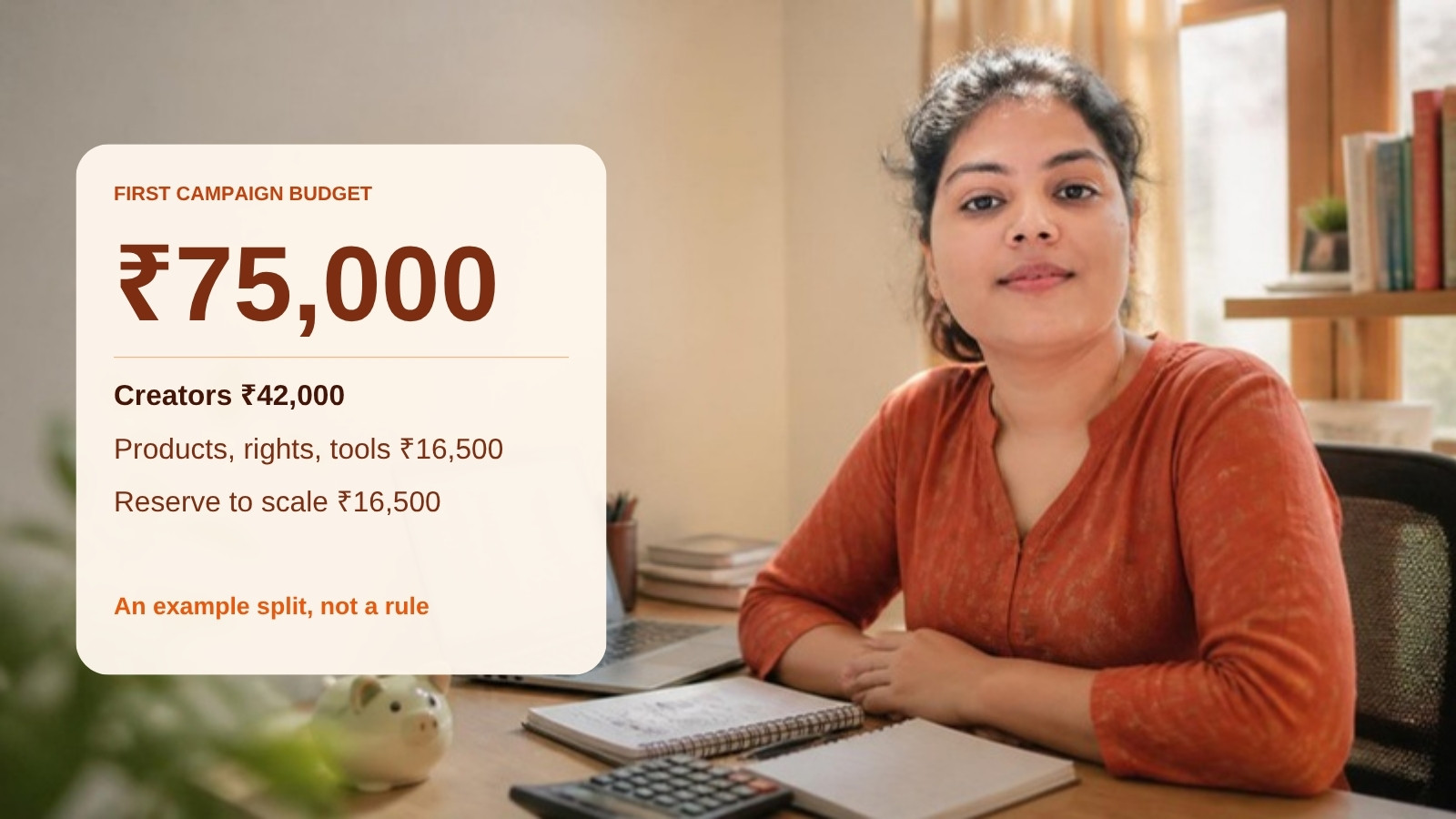
Creator fees are the biggest line, but not the only one. Here is an illustrative split of a ₹75,000 test budget. Adjust it to your own product:
| Line item | Example amount | Why it is there |
|---|---|---|
| Creator fees | ₹42,000 | For example, six small creators at around ₹7,000 each |
| Products and shipping | ₹6,000 | Samples for each creator and courier costs |
| Usage rights | ₹7,500 | Permission to reuse the best videos in your ads and on your site |
| Tracking and tools | ₹3,000 | Link shortener, a simple sheet or a discount-code setup |
| Reserve to scale | ₹16,500 | Held back to put behind whichever creators clearly worked |
| Total | ₹75,000 |
The reserve is the part most first-time brands skip. Without it, you learn what worked but have no money left to act on it.
Paid or product-only deals?
Many small brands begin with product-only (barter) deals for nano creators. This can work for a first read on the product, but expect less commitment and more variation in quality, since the creator is not being paid for their time. Free products still count as a material connection under ASCI's influencer guidelines, so they should be disclosed with a clear label such as #ad or the paid partnership tag. Put that in the brief (see how to write a creator brief).
How to decide whether to scale
After 30 days, work out three simple numbers per creator:
- Cost per thousand views: what you paid divided by views, times 1,000.
- Cost per order: what you paid divided by orders from that creator's link or code. Use unique ones so you can tell (see how to track a campaign).
- Cost per usable video: what you paid divided by videos you would actually reuse.
Put your reserve behind the creators who are best on the number that matches your goal, and drop the rest. Do not scale because one video looked good. Scale because a creator repeatedly moved the metric you care about.
Mistakes that waste a small budget
- Putting most of it on one creator. One flop then ends the campaign.
- Paying everything upfront. Pay in stages, as in how to pay for results.
- Forgetting non-creator costs. Shipping, rights and tracking add up.
- Adding an agency before you know what works. Fees or a margin sit on top of creator costs, so compare in agency or do it yourself.
A budget that cannot overrun
If you want a hard ceiling, a contest gives you one. On EarnLeague, you choose the prize pool, it is funded and held in escrow before the contest goes live, and that pool is the most you spend on prizes. It does not guarantee sales, and it works best for goals like awareness and content volume. To see if it fits, create a campaign.
Start with a budget small enough to lose part of and structured enough to learn from.
Rates and costs change quickly. Confirm current quotes before you plan your numbers.
Ready to run a campaign?
Set a brief and a prize pool, and creators compete on it.